Monday, June 17, 2019

My First Novel's Inspirations ~ Part 6 ~Servants

Hello and Welcome! So glad you could come! Whether you are a first time visitor or you've been here many times, make sure to subscribe so don't miss any future posts. 

Today, we talk about the servants in my story. Not them specifically, but their positions, what they might have worn, what their job descriptions probably were and the hierarchy of servants. I plan to talk about the select few that made their way into my story, but I am just touching a small part of the types of servants there were and still are in some cases.

Some of the servants in my story had bigger roles than others of course, but I'll try to mention each one anyway to help those who may not know what a certain servant mentioned would have done.


Butler and Housekeeper

"The butler was the highest ranking servant and final authority on everything pertaining to the management of the household. His orders came directly from the master and the power he wielded was absolute. Conversely, as the admiral (or general) of the house, his tushie was on the line more than anyone else. His was a role with incredible responsibility. Imagine the breadth of affairs he was ultimately responsible for! Without superior management skills, a man simply could not rise to butler level. No one became a butler without years of service in lower servant roles and impeccable references.


"The Academy Where Butlers Are Born"

Additionally, and probably most importantly, the butler’s relationship with the housekeeper had to be favorable. She was his right-hand helper, nearly on equal footing, and as mentioned above, with so many servants directly under her command, smooth running of the house critically depended upon these two working in concord. Technically he was the boss over the entire household staff so he could, and probably often did, issue orders whenever and to whoever he needed to. Nevertheless, the butler primarily oversaw the duties of the footmen while the housekeeper oversaw the maids."


Valet and Lady's Maid


"The valet is sometimes referred to as the “gentleman’s gentleman.” Often, in finer homes he was of foreign extraction. In the manner of keeping a “French cook,” many British gentleman sought the skills of a foreign valet. There were certain servants, such as the governess, the valet, etc., who did not quite fit into the categories of upper servants and lower servants. Through his connection to the master of the house the valet was often among others of Society at sporting events, social engagements, etc. This placed the valet in a position to know the latest gossip of those with whom his master associated and made him a figure of “authority” when the upper servants dined in the steward’s quarters. 

The valet was not required to dress in house livery, and most valets dressed in the manner of country gentleman or business owner. His main occupation was to make certain his master appeared to the best advantage. The valet’s job was to see his master well-dressed and immaculate, to the point that the master was free to wile away his time without fretting." 

"a lady’s maid needed to have an arsenal of various skills, and many of a lady maid’s talents were connected with her mistress’s toilette and wardrobe. Duties included selecting clothing and millinery that highlighted and improved her mistress’s complexion and figure. It also meant a lady’s maid was responsible to protect, maintain, and repair her mistress’s skin so that she would be less likely to suffer from age spots, freckles, pimples, moles, warts, wrinkles, or other skin imperfections. Headdresses and hairstyles were another vital component of a mistress’s toilette, and no woman wanted to look ridiculous just to be in vogue. A lady’s maid also had to balance the latest fashions, makeup, and millinery styles with her mistress’s physical advantages and disadvantages. Moreover, the lady’s maid had to ensure that when her mistress stepped into the street, the mistress reflected her best work." 


Chambermaid and Grounds Keepers

You may hear these servants called by other names such as, Housemaid, Upstairs maid or Gardener, but their titles are pretty self explanatory, but...

"Chambermaids:  Attended to the chambers or rooms.  Dusted, swept, made beds, warmed beds, took care of fires, attended dressing room, and cared for windows." 


"the housemaid or the chamber maid empties the slops, keep up the fires both in this and the bedroom (if wanted) and keeps the rooms in perfect order. Previous to her mistress retiring for the night she will have looked out her night clothes and aired them well; and she will not only now but at all times when she goes to dress carry up hot water for washing etc and when she is gone to bed she will carefully examine all her clothes and do all that is necessary to be done to them before she folds them away."

I enjoyed learning about the English gardens in my research. The skill it took to design and maintain the gardens, lawns, walkways, lakes, etc., is quite impressive.

"All of the groundsmen from the boss on down were far more than simple gardeners. There wasn’t a single chore from cutting the grass to erecting an elaborate structure to clearing the paths of debris that they weren’t responsible for and prodigiously skilled at. Above all, be assured that these men (and women) perfected their art with passion and loving care. Furthermore, they weren’t only in charge of the ornamental pleasure gardens but also the extensive herb and kitchen gardens, and fruit bearing trees required to feed the family and guests."


Coachman, Stable boys and The Page

"Coachmen were the people entrusted with the management of a person’s carriage and horses. It was important they be reliable, honest, and wise, as a traveler’s safety depended on these traits. For instance, when traveling in a coach, loose nuts and bolts occurred frequently. “A Careful Coachman” was said to be the person willing to check the coach every fortnight for any possible loose nuts or bolts and then screw them tight but also do it with such 'care [as to] not to injure the Paint with the Wrench.'"


"A groom or stable boy is a person who is responsible for some or all aspects of the management of horses and/or the care of the stables themselves. The term most often refers to a person who is the employee of a stable owner, but an owner of a horse may perform the duties of a groom, particularly if the owner only possesses a few horses."


"In medieval times, a page was an attendant to a knight; an apprentice squire. A young boy served as a page for seven years, from the age of seven (after cutting hair) until he was fourteen. At age fourteen, he could graduate to become a squire, and by age 21, perhaps a knight himself. Similar pages served in castles, and great houses fetching things and running messages for aristocrats and royalty. These boys were often the scions of other great families who were learning the ropes of the manorial system by watching and learning. Their residence in the house served as a goodwill gesture between the two families involved and helped them gain political contacts for their adult lives. A reference to this kind of page is found in the Christmas carol "Good King Wenceslaus": "Hither, page, and stand by me, if thou know'st it, telling...."

"Boys of humble background might also gain a similar place in a great house. According to the International Butler Academy , these pages were apprentice footmen. Unlike the hall boys, who did heavy work, these pages performed light odd jobs and were liveried when the aristocrat was entertaining."

The following pictures aren't from my time period, but they give a representation of a Page.


Servant Hierarchy

Credits


That's all I have. I hope you enjoyed a look at the servants that inspired me. Thanks again for coming. If you haven't started the June Read & Review for this month, go to my website to see how you can take part. May God bless you and your family this week with faith, hope and love.

In Christ,
Sandy


SHARE this blog post!
COMMENT below! 
and JOIN me next week!!  


Monday, June 10, 2019

My First Novel's Inspirations ~ Part 5 ~ Men's & Boy's Clothing

Welcome! I'm glad you've come for another visit. I'm going to jump right in today, because if I let it, this one could take awhile, but I'll try to hit the highlights and keep it as short as possible.


Men's Clothing and Accessories


Noblemen and Gentlemen wore suits. Suit coat, pants or breeches, stockings and waistcoat were part of their everyday apparel. Below are pictures of some of the styles that inspired me as I thought about not only my main male character, but minor male characters also. Of course, the more wealthy you were would determine the quality and extravagance of the clothes. Although I didn't address it in my story, some of the very rich would even have jewels sewn into their clothing. 


The Poor Working Man would have had similar styles, but they would have been more likely to leave off a suit coat and gone without or worn a heavier coat. The materials would have been coarser and probably homemade. They also would have worn more neutral colors, because that would have cost less. Just by reason of working and living a harder lifestyle, their clothes would have become worn out sooner.


Cravats and Shoes

The cravat was an early form of a tie. These could be worn in different colors, but white seemed to be the most commonly worn. Also, the cravat could be tied in a variety of ways from fancy to plain. Here are some examples of the cravat.


I personally think that look is pretty attractive, maybe it'll come back in style one of these days...

Here are some shoes that would have been worn. I'm not really looking for these to come back. They speak for themselves.


Hats, Wigs and Hairstyles

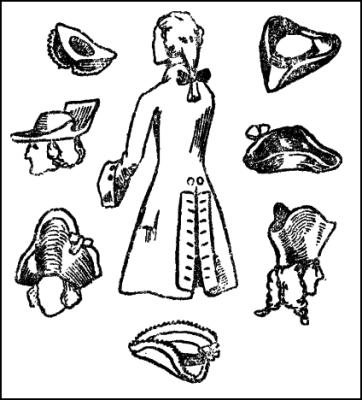
During this time many men wore wigs from the poor to the rich. Just like the clothes, they could be extravagant or simple. Hats were worn as part of their outfits. The gaps were wide between the wealthy and poor. Each part of the dress, could be an indicator of what class a person belonged to. Hairstyles were worn short or long. Many would keep their hair short though since they wore wigs.


Poor Boy's Clothing (the street urchin)

Most of the clothing during this time period for children, simply looked like small adult clothing. I didn't have any wealthy children in my story, so I didn't spend my time there, but I do have some adults and children servants I'll plan to talk about in another post. Here are a few examples of what the poor boys of the time may have dressed like.


If I'm thinking of the poor children in England's past, my mind goes to Oliver Twist by Charles Dickens. Who remembers the pitiful children of that story, especially Oliver? 


So, there you have it. I know I had more pictures this week and didn't write as much, but a picture is worth a....ooops a writer can't say that! 😉 

Anyway, come back again next week, where I plan on looking at some of the servant's inspirations for my story.  If you are enjoying this series, I'd love to hear about it in the comments below!

Come visit my website, I've been making some updates. You'll also learn about our Read & Review for this month. It's not too late to start. Hint: You don't have to buy a book this time.

So glad you came! May God bless you and yours this week with faith, hope and love. 

In Christ,
Sandy

SUBSCRIBEFOLLOW and LIKE 

SHARE this blog post!
COMMENT below! 
and JOIN me next week!! 


Monday, June 3, 2019

My First Novel's Inspirations ~ Part 4 ~ Horses

Hello and happy Monday. I played hooky last Monday, so I could celebrate Memorial Day with my family. I hope you also took time to think about those men and women who have given their lives in the cause of freedom. I also want to thank the families of those lost for the sacrifices you've made for our country. I thank God for you and your lost loved ones.


~~~~~~~~~~~~~~~~~~~~~~~~~~~~~~~~~

Let's continue our look into my first novel's inspirations. Today we talk about HORSES! Although I know how to ride a horse, a nice calm well-trained horse 😁 I enjoy watching them just as much. Their beauty, grace and power is really awe-inspiring. 


During the time period of my story (18th century), horses were an important part of everyday life. I wanted to make sure I wrote the right kind of horse into my scenes. Different horses were used for different jobs. Carrying people, pulling wagons, pulling carriages, pulling a plow, etc., whatever the job, I needed to research the horse used during that time period for that particular work. 


My main male character's horse was especially important to me. I wanted him to have a fast, beautiful horse. I started researching famous racehorses back in the 18th century.


The Darley Arabian


"Scientists at Trinity College, Dublin, have found that at least 95 per cent of male thoroughbreds are descendants of the Darley Arabian, which was imported into Britain from Syria in 1706.


The offspring of these three stallions, and of up to 200 other horses imported from Turkey, Syria and Persia about the same time, evolved into the thoroughbred breed - the fastest and most valuable in the world at the heart of the racing industry.
The Darley Arabian was put out to stud privately, and although he did not serve many mares he sired Flying Childers, the first great racehorse, and Bartlet's Childers, the founder of the Eclipse line.

For two centuries it has been assumed that all the imported horses played a role in the development of the breed, but the work at Trinity has singled out the Darley Arabian as the dominant horse." 

To read the whole article, follow this link. When I read about the Darley Arabian siring the first great racehorse Flying Childers, I knew my main male character's horse needed to be a descendant of that horse. So, in honor of Flying Childers, my horse is named: Flying Brave.

Shire 

The Shire horses in my book are being used to pull a delivery wagon, which is just the sort of thing they are bred for. They are lovely, large and strong, but in my story they have paid their dues and should be enjoying their old age out in the pasture grazing, but they aren't. Poor things...

"Shire, draft horse breed native to the middle section of England. The breed descended from the English “great horse,” which carried men in full battle armour that often weighed as much as 400 pounds. Shires were improved as draft and farm animals in the latter part of the 18th century by breeding mares from Holland to English stallions. In 1853 the first Shire was imported to the United States, but the breed never became popular there and was primarily bred to upgrade smaller farm horses.

Shire stallions average slightly more than 17 hands (68 inches, or 173 centimetres) in height and weigh as much as 2,000 pounds (about 900 kilograms). Generally massive and somewhat coarse in build, they are characterized by considerable hair, called feather, on their legs and are usually bay, brown, black, gray, or chestnut. In 1878 the Shire Horse Society was established in England; the American Shire Horse Association was founded in 1885." 

To read more follow this link

Percheron

The Percheron is another large horse, normally used as a draft horse as well, but in my story, this is my villain's riding horse. Although, I hate to make this beautiful horse carry my bad guy around, some poor creature had to do it. He didn't deserve a stallion like my good guy, so he's stuck plodding along on this horse, better suited for pulling a coach.


"Percheron, heavy draft-horse breed that originated in the Perche region of France. The breed probably stems from the Flemish “great horse” of the Middle Ages; modified by Arabian blood to develop a coach-horse type, it was changed again in the 19th century by introduction of draft-type blood to produce animals for heavy farm work. Although a few Percherons were imported earlier, they did not become popular draft animals in the United States until after 1851. Before mechanization revolutionized farming, Percherons were widespread and influenced American agriculture more than any other draft breed.

Percherons average 16 to 17 hands (64 to 68 inches, or 163 to 173 cm) high and weigh 1,900 to 2,100 pounds (860 to 950 kg). The head is fairly small and clean cut, the neck long, and the body well muscled. Common colours are black and gray. Percherons are agile and energetic for their size and display a mild disposition. The Percheron Horse Association of America and its predecessor organizations date from 1902." 

To read more follow this link


Cleveland Bay

The Cleveland Bays in my story have a brief scene, but they are still worth the mention. They have the job of pulling some important characters to an important destination in a carriage. Here is more about them:


"The Cleveland Bay is the oldest breed of horse indigenous to the United Kingdom. It takes its name from the area in which it was bred, which included Cleveland and the North Riding of Yorkshire in northeast England.

For many years, the Cleveland Bay was considered the best and most powerful coach horse. Eventually, with the industrial revolution and a need for speed, the Cleveland Bay fell out of favor and the Yorkshire Coach Horse (a Cleveland Bay/Thoroughbred cross) gained popularity." 


To read more follow this link


Bonus: The Carriage Inspiration


There you have it. I hope you enjoyed learning a little about these horses that have found their way into my story. Just for fun, here is me a few years back with my own horse. She is a Line Back Dunn Quarter Horse named Jessie. 


Thanks for stopping by! May God bless you and your family the rest of the week. Come back soon!

In Christ,
Sandy

SUBSCRIBEFOLLOW and LIKE 
SHARE this blog post!
COMMENT below! 
and JOIN me next week!!