Monday, June 10, 2019

My First Novel's Inspirations ~ Part 5 ~ Men's & Boy's Clothing

Welcome! I'm glad you've come for another visit. I'm going to jump right in today, because if I let it, this one could take awhile, but I'll try to hit the highlights and keep it as short as possible.


Men's Clothing and Accessories


Noblemen and Gentlemen wore suits. Suit coat, pants or breeches, stockings and waistcoat were part of their everyday apparel. Below are pictures of some of the styles that inspired me as I thought about not only my main male character, but minor male characters also. Of course, the more wealthy you were would determine the quality and extravagance of the clothes. Although I didn't address it in my story, some of the very rich would even have jewels sewn into their clothing. 


The Poor Working Man would have had similar styles, but they would have been more likely to leave off a suit coat and gone without or worn a heavier coat. The materials would have been coarser and probably homemade. They also would have worn more neutral colors, because that would have cost less. Just by reason of working and living a harder lifestyle, their clothes would have become worn out sooner.


Cravats and Shoes

The cravat was an early form of a tie. These could be worn in different colors, but white seemed to be the most commonly worn. Also, the cravat could be tied in a variety of ways from fancy to plain. Here are some examples of the cravat.


I personally think that look is pretty attractive, maybe it'll come back in style one of these days...

Here are some shoes that would have been worn. I'm not really looking for these to come back. They speak for themselves.


Hats, Wigs and Hairstyles

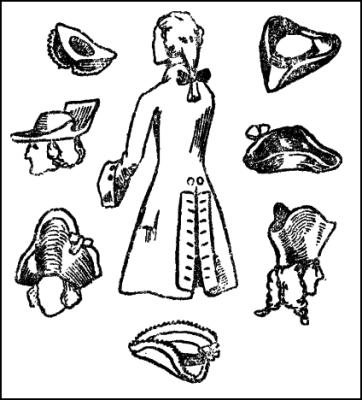
During this time many men wore wigs from the poor to the rich. Just like the clothes, they could be extravagant or simple. Hats were worn as part of their outfits. The gaps were wide between the wealthy and poor. Each part of the dress, could be an indicator of what class a person belonged to. Hairstyles were worn short or long. Many would keep their hair short though since they wore wigs.




Poor Boy's Clothing (the street urchin)

Most of the clothing during this time period for children, simply looked like small adult clothing. I didn't have any wealthy children in my story, so I didn't spend my time there, but I do have some adults and children servants I'll plan to talk about in another post. Here are a few examples of what the poor boys of the time may have dressed like.


If I'm thinking of the poor children in England's past, my mind goes to Oliver Twist by Charles Dickens. Who remembers the pitiful children of that story, especially Oliver? 


So, there you have it. I know I had more pictures this week and didn't write as much, but a picture is worth a....ooops a writer can't say that! 😉 

Anyway, come back again next week, where I plan on looking at some of the servant's inspirations for my story.  If you are enjoying this series, I'd love to hear about it in the comments below!

Come visit my website, I've been making some updates. You'll also learn about our Read & Review for this month. It's not too late to start. Hint: You don't have to buy a book this time.

So glad you came! May God bless you and yours this week with faith, hope and love. 

In Christ,
Sandy

SUBSCRIBE, FOLLOW and LIKE 

SHARE this blog post!
COMMENT below! 
and JOIN me next week!! 


Monday, June 3, 2019

My First Novel's Inspirations ~ Part 4 ~ Horses

Hello and happy Monday. I played hooky last Monday, so I could celebrate Memorial Day with my family. I hope you also took time to think about those men and women who have given their lives in the cause of freedom. I also want to thank the families of those lost for the sacrifices you've made for our country. I thank God for you and your lost loved ones.


~~~~~~~~~~~~~~~~~~~~~~~~~~~~~~~~~

Let's continue our look into my first novel's inspirations. Today we talk about HORSES! Although I know how to ride a horse, a nice calm well-trained horse 😁 I enjoy watching them just as much. Their beauty, grace and power is really awe-inspiring. 


During the time period of my story (18th century), horses were an important part of everyday life. I wanted to make sure I wrote the right kind of horse into my scenes. Different horses were used for different jobs. Carrying people, pulling wagons, pulling carriages, pulling a plow, etc., whatever the job, I needed to research the horse used during that time period for that particular work. 


My main male character's horse was especially important to me. I wanted him to have a fast, beautiful horse. I started researching famous racehorses back in the 18th century.


The Darley Arabian


"Scientists at Trinity College, Dublin, have found that at least 95 per cent of male thoroughbreds are descendants of the Darley Arabian, which was imported into Britain from Syria in 1706.


The offspring of these three stallions, and of up to 200 other horses imported from Turkey, Syria and Persia about the same time, evolved into the thoroughbred breed - the fastest and most valuable in the world at the heart of the racing industry.
The Darley Arabian was put out to stud privately, and although he did not serve many mares he sired Flying Childers, the first great racehorse, and Bartlet's Childers, the founder of the Eclipse line.

For two centuries it has been assumed that all the imported horses played a role in the development of the breed, but the work at Trinity has singled out the Darley Arabian as the dominant horse." 

To read the whole article, follow this link. When I read about the Darley Arabian siring the first great racehorse Flying Childers, I knew my main male character's horse needed to be a descendant of that horse. So, in honor of Flying Childers, my horse is named: Flying Brave.

Shire 

The Shire horses in my book are being used to pull a delivery wagon, which is just the sort of thing they are bred for. They are lovely, large and strong, but in my story they have paid their dues and should be enjoying their old age out in the pasture grazing, but they aren't. Poor things...

"Shire, draft horse breed native to the middle section of England. The breed descended from the English “great horse,” which carried men in full battle armour that often weighed as much as 400 pounds. Shires were improved as draft and farm animals in the latter part of the 18th century by breeding mares from Holland to English stallions. In 1853 the first Shire was imported to the United States, but the breed never became popular there and was primarily bred to upgrade smaller farm horses.

Shire stallions average slightly more than 17 hands (68 inches, or 173 centimetres) in height and weigh as much as 2,000 pounds (about 900 kilograms). Generally massive and somewhat coarse in build, they are characterized by considerable hair, called feather, on their legs and are usually bay, brown, black, gray, or chestnut. In 1878 the Shire Horse Society was established in England; the American Shire Horse Association was founded in 1885." 

To read more follow this link. 

Percheron

The Percheron is another large horse, normally used as a draft horse as well, but in my story, this is my villain's riding horse. Although, I hate to make this beautiful horse carry my bad guy around, some poor creature had to do it. He didn't deserve a stallion like my good guy, so he's stuck plodding along on this horse, better suited for pulling a coach.


"Percheron, heavy draft-horse breed that originated in the Perche region of France. The breed probably stems from the Flemish “great horse” of the Middle Ages; modified by Arabian blood to develop a coach-horse type, it was changed again in the 19th century by introduction of draft-type blood to produce animals for heavy farm work. Although a few Percherons were imported earlier, they did not become popular draft animals in the United States until after 1851. Before mechanization revolutionized farming, Percherons were widespread and influenced American agriculture more than any other draft breed.

Percherons average 16 to 17 hands (64 to 68 inches, or 163 to 173 cm) high and weigh 1,900 to 2,100 pounds (860 to 950 kg). The head is fairly small and clean cut, the neck long, and the body well muscled. Common colours are black and gray. Percherons are agile and energetic for their size and display a mild disposition. The Percheron Horse Association of America and its predecessor organizations date from 1902." 

To read more follow this link


Cleveland Bay

The Cleveland Bays in my story have a brief scene, but they are still worth the mention. They have the job of pulling some important characters to an important destination in a carriage. Here is more about them:


"The Cleveland Bay is the oldest breed of horse indigenous to the United Kingdom. It takes its name from the area in which it was bred, which included Cleveland and the North Riding of Yorkshire in northeast England.

For many years, the Cleveland Bay was considered the best and most powerful coach horse. Eventually, with the industrial revolution and a need for speed, the Cleveland Bay fell out of favor and the Yorkshire Coach Horse (a Cleveland Bay/Thoroughbred cross) gained popularity." 


To read more follow this link


Bonus: The Carriage Inspiration


There you have it. I hope you enjoyed learning a little about these horses that have found their way into my story. Just for fun, here is me a few years back with my own horse. She is a Line Back Dunn Quarter Horse named Jessie. 


Thanks for stopping by! May God bless you and your family the rest of the week. Come back soon!

In Christ,
Sandy

SUBSCRIBE, FOLLOW and LIKE 
SHARE this blog post!
COMMENT below! 
and JOIN me next week!! 


Monday, May 20, 2019

My First Novel's Inspirations ~ Part 3

Happy Monday! I hope you all had a great weekend and are ready to take on another week's challenges. My husband and I kept all four of our grandchildren this weekend. Our 3 year old twin grandsons, 2 year old granddaughter and 11 month old grandson. We had a great time! 😊 That was the first time we had all of them all by ourselves. We love our grandkids and enjoyed them so much, but I must admit, I am dragging a little today. My house also looks like a small cyclone went through it. That isn't really the kids fault, though. That's from me putting my time into them, instead of my regular chores. We also did a good bit of rearranging and baby proofing beforehand, so all that needs to be put back into order.


Today, I want to talk about some of the animals that show up in my story. Anyone who knows me, knows I love animals, especially those that may be found on a farm. I knew I wanted my main female character to be a farm girl. Figuring out what kind of farm, took a little research. In the rural area of England where my character Charity is from, sheep farms are common. 

I didn't know much about sheep, except what the Bible has to say about them. Here's a couple of the many passages from the Bible, where sheep are used as a comparison to God's people.

Ezekiel 34:11-16 ESV
 “For thus says the Lord God: Behold, I, I myself will search for my sheep and will seek them out. 12 As a shepherd seeks out his flock when he is among his sheep that have been scattered, so will I seek out my sheep, and I will rescue them from all places where they have been scattered on a day of clouds and thick darkness. 13 And I will bring them out from the peoples and gather them from the countries, and will bring them into their own land. And I will feed them on the mountains of Israel, by the ravines, and in all the inhabited places of the country. 14 I will feed them with good pasture, and on the mountain heights of Israel shall be their grazing land.There they shall lie down in good grazing land, and on rich pasture they shall feed on the mountains of Israel. 15 I myself will be the shepherd of my sheep, and I myself will make them lie down, declares the Lord God. 16 I will seek the lost, and I will bring back the strayed, and I will bind up the injured, and I will strengthen the weak, and the fat and the strong I will destroy. I will feed them in justice."

John 10:11-15 ESV
I am the good shepherd. The good shepherd lays down his life for the sheep. 12 He who is a hired hand and not a shepherd, who does not own the sheep, sees the wolf coming and leaves the sheep and flees, and the wolf snatches them and scatters them. 13 He flees because he is a hired hand and cares nothing for the sheep. 14 I am the good shepherd. I know my own and my own know me, 15 just as the Father knows me and I know the Father; and I lay down my life for the sheep.

Sheep

I had dallied with the idea of a dairy farm, but the sheep won out. I liked the way they worked into my springtime story. The shearing and lambing of sheep in the spring appealed to me. I also read about much of the process from shearing to spinning the wool. Although, I couldn't go into any detail, in my story, I tried to touch on some of the steps, briefly at different points.My story takes place in the mid 18th century. The industrial revolution didn't begin in England until the later part of the 18th century. This means most of the work done to prepare the wool for sale or personal use, was either done by hand or by simple machinery such as a spinning wheel. 


18th Century Spinning Wheel 

I thought the type of sheep, would be important to mention, too. I chose the Leicester Longwool Sheep.


I put them in my story, because I liked what I read about the quality of their wool, their uniqueness and because they were described as docile. My story is a few years ahead of their actual "development" but I wanted them in my story, so they made it in anyway. 😄


Leicester Longwool Sheep

Donkeys

I mention donkeys briefly a couple times. The reason I wanted them in my story, is that I learned that donkeys were and still are in some places, kept with sheep because they can protect the sheep from predators. They don't really protect the sheep, because they care about them, but because they don't like strange creatures in their space. 


There are a good many videos of donkeys doing their thing on YouTube, if you are interested. For time sake, I'll move on.


Sheep Dogs and Chickens

I briefly mention sheep dogs in my story, but I didn't do more than that. I probably should have put some time into them, because sheep dogs are an important part of a sheep farm. I allude to the fact that there are chickens on the farm, but only talk about the gathering of their eggs. I have chickens and enjoy them. I probably could have written a chapter about Charity with her chickens, but I have to be reasonable. The dogs and chickens, just didn't get a starring role this time. 

Cow 

Charity has a milk cow, that makes it into a couple scenes. My research of the cow, basically revolved around how the milk in that time period, would have been kept cold. Thus, I spent more time researching the springhouse, than I did the cow. One of the reasons writing a book can take so long, is research. You can chase a rabbit down a hole and not come up for hours. This was one of those times for me. I found the springhouse so interesting. Maybe I should have been more interested in the cow, but she still gets to shine a little. 🌟


Goats 

I talk about goats a couple of times in my story, but one goat is special. I know this is going to sound weird, but I have a stuffed goat my husband bought me on a trip we took to Pidgeon Forge, Tennessee for our 25th wedding anniversary. Since I got the goat, it has sat on the dashboard of my car. I call her Nanny and we make jokes about her leading the way on every trip since. Yes, I know, LAME, but we have our silly fun with it and I really like my goat. My husband bought it from a place dedicated to goats. At the zoo, I am right there along the kids (no pun intended) in the petting zoo, visiting the goats. I don't know why I like goats so much, but I do. They are cute. Anyway, there is a special part for a nanny goat in my story. 


Horses 

I talk about horses the most in my book. They were used in so many ways, during that time period, they needed to be a big part of my story. I won't talk about them today, though, since it will take me a little longer than the rest of the animals. Next week, I'll plan to focus on them for Part 4. I hope you'll join me again for that.

I think that covers it. I hope you enjoyed learning a little of the back story. When and if you read my book, I hope you enjoy reading about the animals as much as I enjoyed writing about them.

Have a great week! May you and your family be blessed with faith, hope and love in the Lord Jesus.

In Christ,
Sandy

SUBSCRIBE, FOLLOW and LIKE 

SHARE this blog post!
COMMENT below! 
and JOIN me next week!! 


Monday, May 13, 2019

My First Novel's Inspirations ~ Part 2

Hello and happy Monday. I'm glad you could stop by for a visit. I hope all you Mother's out there had a special day yesterday. I know I did. I feel so blessed to have the family I have and I am thankful for the extra effort they put into making me feel special on Mother's Day.

Today, I am continuing my series on my novel Hope for Charity and the things that inspired me as I wrote. Last week I talked about the process of choosing a starting point for my story, Husthwaite, North Yorkshire, England. I also talked about why I chose that particular time period. If you missed that post, make sure you click here to see it. 


This week, I want to talk about the season in which my novel takes place, spring. I love springtime. New leaves, flowers, plant life, baby birds and animals beginning life. It's a time of newness, freshness, hope. Especially after a hard winter, springtime can feel like a new start. 

That's what I wanted my book to encapsulate...hope. The title of my novel Hope for Charity, has two meanings. Charity is the name of my main female character, but charity also means love. So the title could mean, Hope for Charity the person or Hope for Charity or Love. I think either way, it's true for my story.

Since I wanted my story to take place in the spring, or more accurately the beginning of spring, I wanted to know what springtime in North Yorkshire looked like. What type of flowers, trees and birds would I see? What would be happening on a farm in the spring? Today, I'll focus on some of the flowers, trees and birds you may see if you were in Charity's world in the springtime.


"English oak is a large deciduous tree up to 20-40m tall. In England, the English oak has assumed the status of a national emblem. As common oaks mature they form a broad and spreading crown with sturdy branches beneath. Their open canopy enables light to penetrate through to the woodland floor, allowing bluebells and primroses to grow below. Their smooth and silvery brown bark becomes rugged and deeply fissured with age. Oak tree growth is particularly rapid in youth but gradually slows at around 120 years. Oaks even shorten with age in order to extend their lifespan." 


"When fully grown, ash trees can reach a height of 35m. Tall and graceful, they often grow together, forming a domed canopy. The bark is pale brown to grey, which fissures as the tree ages. Easily identified in winter by smooth twigs that have distinctively black, velvety leaf buds arranged opposite each other."

Blue Bells


Primrose


The Blue bell and Primose are flowers I chose to put in my novel, because of their beautiful colors and designs. The variety and beauty of the flowers in England in the springtime is something worth seeing. If you love flowers, you may want to do your own search. 

Chaffinch


The pretty little Chaffinch made it into my story. I love birds, so if I'd have had more words to spare, I could have written about many more bird varieties.


There you have it, a taste of spring in the English countryside. Looking at all this beauty and new life, I can't help but have hope. Did Charity feel the same? We'll see...

Look around. You don't have to go to England to see the beauty and hope of spring. God reveals Himself in nature, everywhere. He created it all to reveal His glory to us, to reveal Himself to us. Don't get it backwards, though. Don't worship the creation. Worship the Creator, The Lord God.

May God bless you and your family, as you enjoy Him through His creation this spring.

In Christ,
Sandy

SUBSCRIBE, FOLLOW and LIKE 

SHARE this blog post!
COMMENT below! 
and JOIN me next week!! 


Footnotes: Image 1, Image 2


Monday, May 6, 2019

My First Novel's Inspirations ~ Part 1

Good morning and happy Monday! I hope y'all had a great weekend. Mine went along as normal for the most part, but yesterday ended with tears. Stick around to the end and I'll tell you a little about that.


Today, I am starting a series (not sure how many parts it will take yet) about my first novel's inspirations. Some of the things I started out searching for, because they were already on my mind and others I found along the way as my story went progressed or during my research.  


This is a fiction novel, so although I used these different places, people, things, etc. as inspirations, they may have been changed  to fit my imagination as I saw fit. It's called Creative License. So, if you see this and then read my book one day, don't expect exact representations. 


Husthwaite, North Yorkshire, England 1747

This is where and when my novel Hope for Charity begins. I had in my mind from the very beginning, the type of place I wanted my main female character to live. I wanted her to be a farmer's daughter in rural England. (I'll plan to talk about the farm in a later post.) It took awhile for me to find the perfect place, at least in my mind. I needed her home to be in a location that would work with the various scenes transpiring in my story. I wanted the farm to be near a village, not a town. I felt the lower population, would suit her situation better. My story also leads us to other locations in England. The roads, waterways, travel times and so on, all needed to be considered. While writing my novel, I tried to be as accurate as I could. I am still learning how to research and where to do my research. I'm sure with each new book I write (Lord Willing), I will have found new and better ways to hunt down the information I need. 


Find the painters information here.

Why 1747?

I didn't want my story to revolve around wars. The two wars my story is squeezed between, are the Jacobite rebellion and the Revolutionary war. Although, those would make for great stories. It wasn't the story I had to write this time. I also wanted my novel to be set in a time period that would severely restrict my female character's options. Choosing this time period, didn't come easy. I had to take many things into consideration. I spent many times with my calculator, trying to do the math to see if my tale would work with the real historic information I found. If you know me at all, you know that I am not a math person. So, for all the history buffs or math geniuses out there, give me a break. I don't claim to be either and again I do claim Creative License. 😁 


18th century map of England
Husthwaite Today

Husthwaite is still a village today. It's population is around 400. They are known for their apple orchards and sheep farms. When looking at recent pictures of the area, I imagine, that things probably don't look a whole lot 
different from the area in the 18th century. Of course roads would be better and modern conveniences would be available now, but the land and at least some of the buildings, probably look much the same. Trip Advisor will even tell you the best things to do in Husthwaite. Another site touts it as "The Best Village in The North of England". I already know that. 😊 But I really would love to go visit it someday. 


In my novel, I don't have time to talk about all the places and things to see and do around Husthwaite. If I wrote a sequel, I might could get more of them in there, but that's not in my immediate plans. So, check out some of the sites linked above and see what you think of the place my story begins...Husthwaite.

A little bit personal...

My weekend went sour, when our family dog of 10 years passed away yesterday. We knew for the last few days, that it could happen, but I really hoped she would rally and be ok. She lived a good long life and she will be missed. She was a sweet dog, who happily greeted us anytime we came near. I'm glad she didn't seem to suffer and went peacefully. I'm thankful for the years the Lord gave her to us to enjoy and love. Goodbye, Taffy. 


Housekeeping: 


SUBSCRIBE, FOLLOW and LIKE 


SHARE this blog post!
COMMENT below! 
and JOIN me next week!!